Something odd happens when you're packed into a stadium or a temple with thousands of other people, all doing the same thing at the same time. Heart rates start matching. Brainwaves lock onto the beat. People feel things they don't feel alone.
We usually describe this as "getting swept up in the crowd," which frames it as a failure of individual judgment. That framing might be backwards. The evidence increasingly suggests that merging with a group isn't something that happens to you, a glitch in otherwise rational processing. It's something the body knows how to do on purpose.
The body goes first
In 2011, researchers traveled to a village in northern Spain to instrument a fire-walking ritual that had been practiced there for generations. They strapped heart rate monitors to 12 fire-walkers, 9 of their relatives or friends watching from the crowd, and 17 strangers who had come to observe.1
What they found was striking. During the 30-minute ritual, as 28 participants crossed a 7-meter carpet of coals at 677°C, the heart rates of the walkers and their related spectators moved in synchrony. The strangers' heart rates did not. The family members sitting still in the audience were physiologically locked onto the people walking through fire.
This wasn't due to shared physical activity or proximity. The walkers and their relatives were in completely different parts of the space, doing completely different things. The synchrony had to be informational, the authors concluded: transmitted through the meaning the event held for the people emotionally connected to the participants.1 Social closeness, not shared action, was the mechanism.
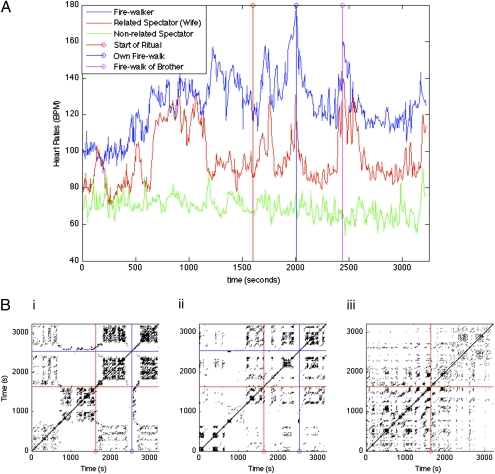 Fig. 1 from Konvalinka et al. (2011).1
The same pattern shows up in controlled settings. A study of 182 fans at NCAA basketball games found that people who attended in person showed significantly greater heart rate synchrony with each other than fans watching on a 102-inch screen in small groups. That synchrony, in turn, predicted stronger feelings of identity fusion and transformative experience.2 The body's coordinated response wasn't just a side effect of being in a crowd. It was doing something.
What the brain is actually doing
In a 2025 study at UCL, 59 audience members wore mobile EEG headsets through three live performances of a contemporary dance piece.3 Their brains synchronized in the delta band, 1-4 Hz, a slow-frequency range associated with social processing and mind-wandering. The synchrony was strongest when performers broke the fourth wall and made direct eye contact with the crowd. When researchers had other groups watch a recording of the same performance, either together in a cinema or alone in a lab, the synchrony weakened. Watching alone nearly eliminated it.
The frequency band matters here. Delta waves are not the brainwaves of focused attention or active processing. They're slow, associated with social engagement and integration. The live crowd experience doesn't seem to be making people more alert in the usual sense. It's pulling them into a different mode.
The chemistry underneath
When you synchronize physically with a group, something chemical happens. Collective rituals, group singing, synchronized dancing, communal prayer, all trigger measurable release of μ-opioids, the same class of neurochemicals targeted by morphine.4 These aren't incidental. Researchers have shown that pain thresholds increase after participation in group prayer, a reliable proxy for opioid activation, and that administering naltrexone, an opioid receptor blocker, eliminates the pro-social bonding effects of the ritual. The bonding depends on the opioids.4
Oxytocin adds another layer. Higher baseline oxytocin levels correlate with self-reported spirituality, and intranasal oxytocin administration increases both spiritual feeling and positive emotions during meditation.4 The neurobiology isn't pointing to a single "group bonding molecule." It's a system, opioids, oxytocin, dopamine from reward activation, working together. But the consistent finding is that shared synchronized action reliably activates it.
The evolutionary logic is not subtle. These are the same systems that bond mothers to infants, that cement pair bonds, that keep small groups from falling apart under stress. Ritual and collective synchronized action seem to borrow the wiring.
The same thing, everywhere
The neuroscience is interesting on its own, but what I find more compelling is how universal the mechanism is, and how consistently it produces the same outcome across radically different cultural contexts.
In Sufism, the practice of dhikr, the repetitive vocalization of divine names, often performed in groups with coordinated breathing, swaying, and movement, is explicitly designed to produce fanāʾ: the annihilation of the self in the Divine.5 The goal is ego dissolution, and the method is rhythm, repetition, and group synchrony. Al-Ghazali's classical model describes it as sustained focus on divine majesty leading to the dissolution of ego-dependency. The 13th-century mystic and the 21st-century EEG study are describing the same cascade.
The mechanism shows up everywhere you look. In Hinduism, the Kumbh Mela generates documented reductions in physical pain from the collective dimension specifically, not from private devotion. In Buddhism, group chanting and deep meditation downregulate the default mode network and produce anattā, no-self, through the same neurobiological pathway. In Islam, the ḥadra circle synchronizes breath and sound until oxytocin rises and individual boundaries dissolve; the Tawaf, millions circumambulating the Kaaba simultaneously, produces the same crowd self-organization Kronsted describes. In Christianity, AME church sermons drive synchronized clapping, call-and-response, and collective vocal intensity until the congregation becomes its own emergent system. In Judaism, the Hasidic niggun repeats melody and movement until the boundary between self and prayer dissolves.
The methods differ. The phenomenology reported, self-dissolution and contact with something larger, does not.
Across anthropological literature, trance and possession states show up in virtually every human culture, including Aboriginal Australian totem ceremonies, North American shamanic traditions, and spirit possession rituals across West Africa and South Asia. Researchers have pushed back hard on the tendency of Western psychiatry to pathologize them.6 These states are adaptive, not aberrant. They serve functions: emotional release, community healing, dispute resolution, social cohesion, and they are, in many cases, specifically sought and induced through collective synchronized action.
Émile Durkheim named this "collective effervescence" in 1912: the heightened energy and sense of unity that emerges when groups gather in shared experience.7 More recently, Christian Kronsted has proposed that this isn't mystical at all, but a consequence of human bodies undergoing high degrees of self-organization as a crowd system. Clapping, chanting, swaying start as chaotic, self-organize into synchrony through positive feedback loops, and the crowd becomes an emergent system with properties that can't be reduced to any individual in it.8
The experience of that self-organization is collective effervescence.
The designed version and the accidental one
Sometimes a musician figures out how to make this happen on purpose. At a concert at Bingley Hall in Stafford, England, on 29 May 1977, Queen finished their set and walked offstage. The audience didn't just clap. They started singing "You'll Never Walk Alone" back at the band, unprompted, with no one conducting. Brian May watched from the wings and went home to write "We Will Rock You."9
The song is a piece of crowd engineering. The stomp-stomp-clap pattern is trivially simple by design: two foot stomps, one hand clap, a pause, repeat. Anyone can do it in the dark, drunk, without knowing the words. For most of the song there is no drum kit, no bass guitar. The rhythm section is the audience.9 May recorded it by having band members stomp on plywood boards in a studio corridor, layering dozens of takes with delay effects to simulate the sound of a stadium.9 The record already sounds like a crowd. When you hear it in an actual stadium, the crowd has become the instrument May designed it to be. He handed 50,000 people a shared periodic signal simple enough for all of them to synchronize around, and the self-organization that Kronsted describes kicks in from there.
Eleven years earlier, the Beatles played Shea Stadium to 55,600 people, at the time the largest concert audience they had faced.10 The PA system was inadequate for the venue. The crowd noise overwhelmed the band so completely that the Beatles couldn't hear themselves play. The 30-minute set was, by most musical standards, a disaster. Scholar Mark Duffett argues that Shea is actually two events: the thing that happened, and the thing that got remembered.11 In the remembered version, the crowd drowning out the band gets coded as the crowd becoming the performance. The screaming was the main event. The music was incidental. But underneath the mythology, something real was happening. Nobody coordinated the screaming. There was no rhythmic scaffold to teach the crowd a pattern. The shared identity, we are Beatles fans, we are here, this is the moment, did the organizing work instead. The Shea crowd found its own way into self-organization without any designed tool to get them there.
The difference is interesting but maybe not as important as it seems. One is engineered crowd participation, the other is emergent. Both end up in the same place: individual bodies coupling to each other through shared rhythm or shared affect, the crowd becoming an emergent system. Brian May designed his way to that state. The Shea crowd stumbled into it. The outcome, measured in synchronized bodies and collective experience, looks the same either way.
"You just had to be there"
One of the stranger findings in this literature is how much being physically present matters. The live-versus-recorded effect on brainwave synchrony is robust. The in-person-versus-televised effect on heart rate synchrony is significant. The fire-walking effect only extends to people socially related to the participants, even when they're sitting still. The phrase "you just had to be there" turns out to be less of a social apology and more of a physiological fact.
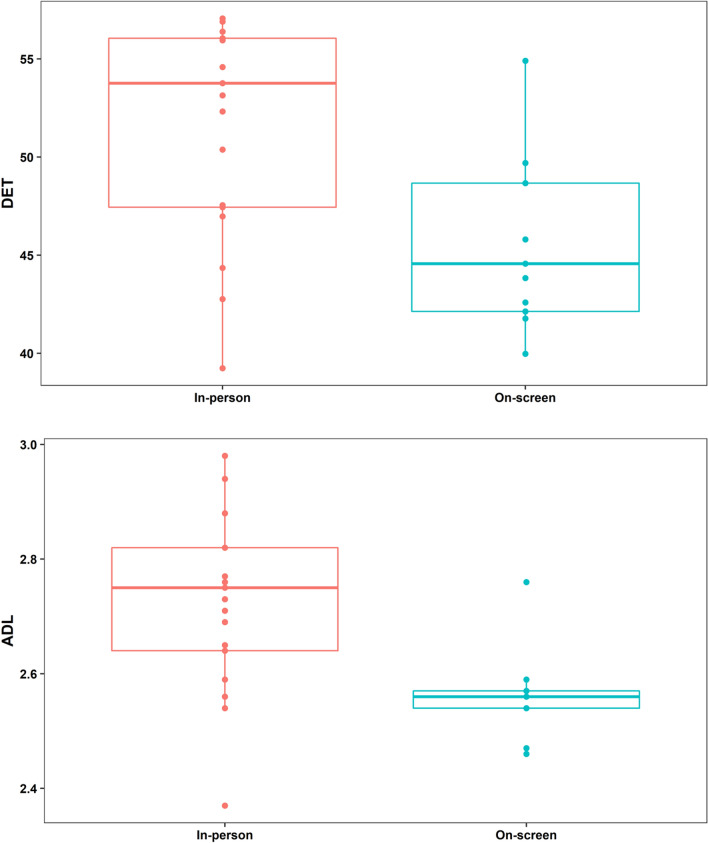 Fig. 3 from Baranowski-Pinto et al. (2022). CC BY 4.0.2
A research group at the University of Buffalo developed a psychometric scale to measure individual differences in the tendency to experience collective effervescence, the TEAM scale.12 In a sample of 150 undergraduates, 34% reported experiencing it within the last week, and only 3% reported never experiencing it. It's not a rare or specialized capacity. But it does seem to require bodies in the same space.
The UCL researchers called this "social liveness," the suggestion that sharing the moment with others is as important as the performance itself.3 That finding has some uncomfortable implications for the claim that livestreams and virtual communities can substitute for physical gathering. They can do many things. But the physiological synchrony, the delta wave entrainment, the opioid release, these appear to require co-presence.
It's not a bug
The default cultural framing of crowd psychology is negative. We talk about losing yourself in a crowd as a warning, as the pathway to mob behavior, to manipulation, to the suspension of individual judgment. Le Bon's 1895 crowd psychology, which cast collective behavior as irrational and primitive, still shapes how we think about this.
But the data points somewhere different. The same capacity for self-dissolution that makes crowds dangerous is what makes ritual, music, and communal experience transformative. The opioid release that cements group identity is the same system that cements the mother-infant bond. The ego dissolution of fanāʾ is the intended endpoint of centuries of refined spiritual practice. The collective effervescence that Durkheim described in tribal rituals and Victor Turner described as communitas are both pointing to the same thing: a state that humans are wired to enter, in groups, that appears to be central to social cohesion, meaning-making, and psychological health.7
The University of Buffalo TEAM scale found that the tendency toward collective effervescence predicts decreased loneliness, increased positive affect, and a sense of meaning in life, independent of the big five personality factors.12 Collective merging is not the absence of individual flourishing. For most people, it seems to be part of it.
I keep coming back to the fire-walking finding. A woman sitting in a crowd, perfectly still, her heart rate locked to her husband's as he walks across burning coals. No shared movement, no direct communication. Just the information available through social love.
That's not losing yourself. That's the body doing exactly what it evolved to do.
Further Reading
Synchronized arousal between performers and related spectators in a fire-walking ritual: Konvalinka et al. (2011), PNAS; the fire-walking study showing that social closeness, not shared action, drives physiological synchrony between performers and spectators.
Delta-band audience brain synchrony tracks engagement with live and recorded dance: Rai et al. (2025), iScience; source for the delta wave synchrony findings and the "social liveness" concept that frames the co-presence argument.
Collective Effervescence as Self-Organization and Enaction: Kronsted (2025), Journal of Social Ontology; the theoretical backbone of this post, reframing collective effervescence as emergent self-organization rather than mystical experience.
Development and Validation of the TEAM Scale: Gabriel et al. (2017), Psychological Assessment; psychometric evidence that the tendency toward collective effervescence predicts decreased loneliness and increased meaning in life.
Beyond Beatlemania: The Shea Stadium Concert as Discursive Construct: Duffett (2015), in The Arena Concert; the scholarly case that Shea Stadium is two events, the thing that happened and the thing that got remembered, used in the crowd participation section.
References
-
Konvalinka et al., "Synchronized arousal between performers and related spectators in a fire-walking ritual," PNAS 108, no. 20 (2011): 8514–8519. https://www.pnas.org/doi/10.1073/pnas.1016955108. The MANOVA of paired synchrony showed a significant main effect of relatedness (p < 0.008) and ritual (p < 0.001). ↩ ↩2 ↩3
-
Baranowski-Pinto et al., "Being in a crowd bonds people via physiological synchrony," Scientific Reports (2022). https://www.ncbi.nlm.nih.gov/pmc/articles/PMC8755740/. In-person attendance showed greater synchrony by both Determinism (p = 0.011, d = 1.089) and Average Diagonal Line length (p = 0.004, d = 1.207). ↩ ↩2
-
Rai, L.A. et al., "Delta-band audience brain synchrony tracks engagement with live and recorded dance," iScience 28, no. 7, 112922 (July 9, 2025). https://www.cell.com/iscience/fulltext/S2589-0042(25)01183-6. Interpersonal neural synchrony in the delta band (1–4 Hz) was highest during live performances; synchrony weakened substantially when viewed alone. ↩ ↩2
-
Tyler, W., "Modulation of Religious and Spiritual Neural Networks for Improving Mental Health," preprint (not peer-reviewed), November 2025. https://www.preprints.org/manuscript/202511.0227/v1. On opioids and prayer: cites studies showing pain threshold increase post-prayer and elimination of bonding effects via naltrexone. On oxytocin: cites Ruff et al. and Colzato et al. on intranasal oxytocin → increased spirituality during meditation. ↩ ↩2 ↩3
-
Arfah Ab Majid & Jia Lie, "Sufi Chanting and Altered State of Consciousness: A Preliminary Review," Sains Insani 10, no. 2 (2025): 28–36. https://sainsinsani.usim.edu.my/index.php/sainsinsani/article/view/748 ↩
-
Goel, V. & Abrol, M., "The Psychology of Trance and Possession: Altered States of Consciousness," Int. J. Contemp. Res. Multidiscip. 4(3):249–254 (2025). DOI: 10.5281/zenodo.15583565. https://multiarticlesjournal.com/uploads/articles/IJCRM20254353.pdf. Literature review drawing on Lewis, Winkelman, Bourguignon, Rouch, and others arguing trance/possession are culturally adaptive, not pathological. ↩
-
Durkheim, É., The Elementary Forms of Religious Life (1912). Summarized and traced in Olaveson, T., "Collective Effervescence and Communitas," Dialectical Anthropology 26, no. 2 (2001): 89–124. https://link.springer.com/article/10.1023/A:1020447706406. Olaveson makes the case for equivalence between Durkheim's collective effervescence and Turner's communitas, both pointing to the human need for dialectical tension between social structure and collective dissolution. ↩ ↩2
-
Kronsted, C., "Collective Effervescence as Self-Organization and Enaction," Journal of Social Ontology 11, no. 1 (2025): 1–27. https://journalofsocialontology.org/index.php/jso/article/view/8732 ↩
-
Brian May, 1977 BBC Radio 1 interview (available on the 6-CD deluxe edition of Queen's On Air compilation, 2016). May described the crowd singing "You'll Never Walk Alone" back at the band after the encore at Bingley Hall in Stafford and said the band were "completely knocked out." He traced "We Will Rock You" directly to that moment. See also Wikipedia, "We Will Rock You." https://en.wikipedia.org/wiki/We_Will_Rock_You. Recording technique: approximately 15 takes of band members stomping on plywood in the Wessex Studios corridor, layered with delay effects. Other than the final 30 seconds containing a guitar solo, the song is set in a cappella form using only stomping and clapping as rhythmic body percussion. ↩ ↩2 ↩3
-
Wikipedia, "The Beatles at Shea Stadium." 55,600 attendees; largest Beatles concert to that date. https://en.wikipedia.org/wiki/The_Beatles_at_Shea_Stadium ↩
-
Duffett, M., "Beyond Beatlemania: The Shea Stadium Concert as Discursive Construct," in R. Edgar, K. Fairclough-Isaacs, B. Halligan, N. Spelman (Eds.), The Arena Concert: Music, Media and Mass Entertainment (pp. 29–44). London: Bloomsbury Academic, 2015. https://chesterrep.openrepository.com/handle/10034/345307 ↩
-
Gabriel, S., Valenti, J., Naragon-Gainey, K., & Young, A., "The Psychological Importance of Collective Assembly: Development and Validation of the Tendency for Effervescent Assembly Measure (TEAM)," Psychological Assessment 29, no. 10 (2017): 1349–1362. https://pubmed.ncbi.nlm.nih.gov/28263640/. Cronbach's α = .88; TEAM accounted for 3.1%–9.9% variance in life outcomes above big five factors. ↩ ↩2